

Choosing the right cooling system is one of the most significant investments a homeowner in Silicon Valley can make. According to the U.S. Energy Information Administration, space cooling accounts for approximately 12% of the average U.S. residential electricity consumption, making efficiency a critical financial factor. In San Jose, where summer temperatures frequently climb above 85 degrees Fahrenheit, selecting between a traditional central air conditioning system and a ductless mini-split setup can drastically impact your comfort, energy bills, and property value. This guide breaks down the technical differences, installation requirements, and long-term costs to help you decide which system aligns with your home’s unique architecture.
Understanding the Cooling Mechanics
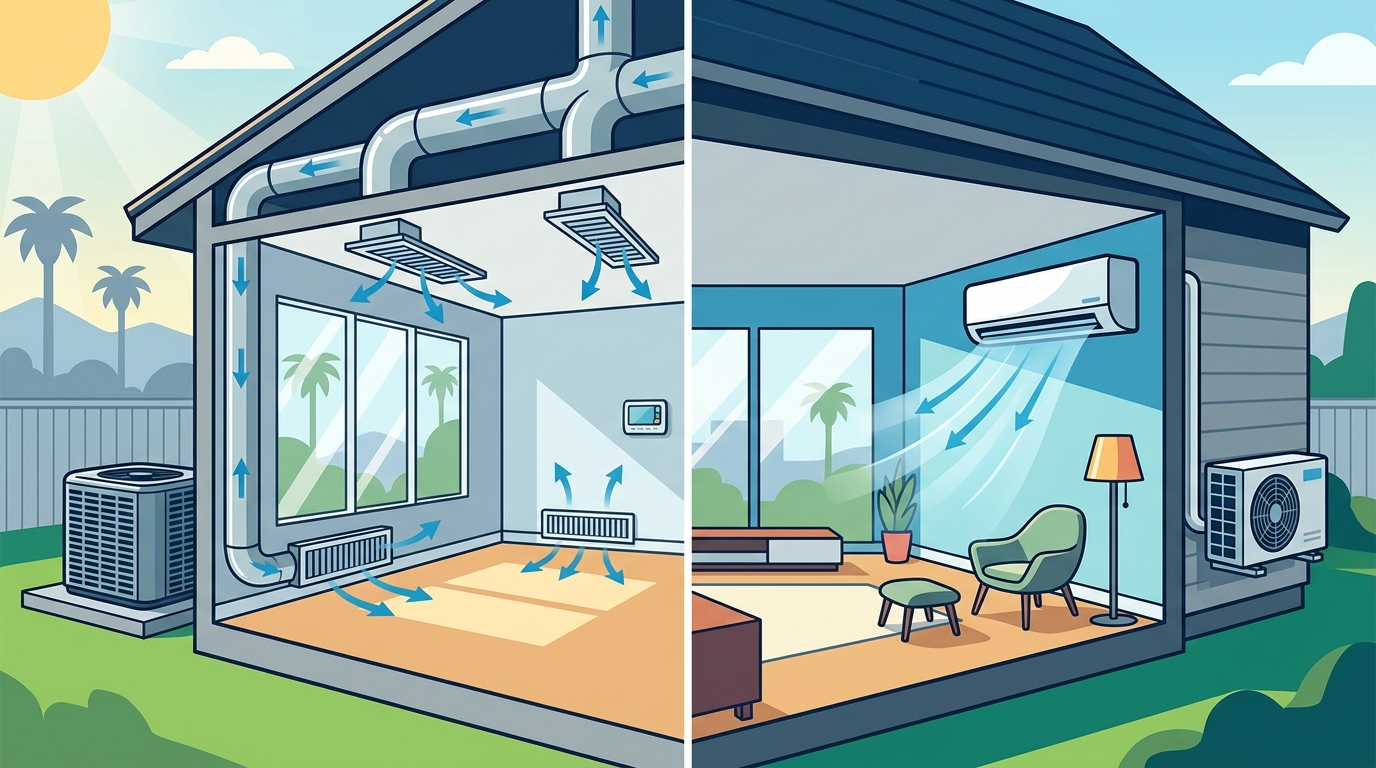
The fundamental difference between these two systems lies in how they distribute conditioned air throughout your living space. Central air conditioning relies on a network of ducts to push cool air from a single central unit to every room. Ductless mini-split systems, on the other hand, use individual indoor air handlers connected to an outdoor compressor via small refrigerant lines.
Central AC systems are best suited for homes that already have existing ductwork. These systems maintain a consistent temperature across the entire house by circulating air through vents located in each room. The technology has been refined over decades, making it a reliable choice for large, open-concept homes in neighborhoods like Almaden Valley or Rose Garden. However, if your home lacks ducts, installing them can be invasive and expensive.
Ductless mini-split systems offer zoned cooling capabilities. This means you can control the temperature in specific rooms independently. For example, you might keep the living room cool during the day while leaving the bedrooms at a higher temperature until evening. This flexibility is particularly valuable in older San Jose homes where adding ductwork is structurally difficult or prohibited by historical preservation guidelines. Air Sharks provides expert air conditioning installation services tailored to both system types, ensuring optimal performance for your specific layout.
Installation Complexity and Ductwork
Installation is often the deciding factor for homeowners weighing these options. Central air conditioning requires extensive construction work if ducts are not already present. Technicians must install sheet metal or flex ductwork throughout the attic, crawl spaces, and walls. This process can take several days and may require drywall repair or ceiling modifications. In contrast, a ductless mini-split system requires only a small three-inch hole through the exterior wall to connect the indoor and outdoor units.
The speed of installation is a major advantage for ductless systems. A professional team can typically complete a multi-zone mini-split installation in just one or two days. This minimizes disruption to your daily routine and reduces labor costs associated with prolonged construction. For homes in areas like Campbell or Los Gatos where preserving the exterior aesthetic is important, mini-splits offer a discreet solution that does not require bulky external vents or extensive piping runs.
However, central air systems are generally more robust for whole-house cooling. If you have a large family and need to cool multiple rooms simultaneously, central AC provides a more uniform environment. Air Sharks ensures that every heating and cooling installation meets California energy standards, guaranteeing that your new system operates safely and efficiently from day one.
Energy Efficiency and Operating Costs
Energy efficiency is a primary concern for San Jose residents looking to reduce their carbon footprint and utility bills. Ductless mini-split systems are generally more energy-efficient than central air conditioning systems. This is primarily because they eliminate the energy losses associated with ductwork. According to the Department of Energy, duct losses can account for more than 30% of energy consumption for space conditioning if the ducts are located in an unconditioned space like an attic. By removing the ducts entirely, mini-splits deliver more of the cooled air directly to the living space.
Central air systems can also be highly efficient, especially when paired with high SEER (Seasonal Energy Efficiency Ratio) ratings. Modern central units often feature variable-speed compressors that adjust their output based on the current temperature, reducing energy waste. However, the efficiency of a central system is heavily dependent on the condition of its ductwork. Leaky or poorly insulated ducts can significantly undermine the system's performance, leading to higher energy bills.
For homeowners in San Jose, the choice often comes down to the condition of their existing infrastructure. If your ducts are in good shape, a high-efficiency central unit may be the most cost-effective upgrade. If your ducts are old or non-existent, a ductless mini-split will likely offer superior long-term savings. Air Sharks offers comprehensive air quality and efficiency assessments to help you determine the best path forward.
Indoor Air Quality and Filtration
Indoor air quality is a growing priority for health-conscious homeowners. Central air systems typically use larger filters that can capture more dust, pollen, and allergens before they circulate through your home. These filters are easier to access and replace, making maintenance straightforward. Additionally, central systems can be integrated with whole-house humidifiers or dehumidifiers, providing precise control over indoor humidity levels, which is beneficial in San Jose's dry summer climate.
Ductless mini-split systems also contribute to better indoor air quality, but through a different mechanism. Each indoor unit has its own multi-stage filtration system that cleans the air in that specific zone. These filters are highly effective at removing fine particles and odors. However, because the air is not circulated through a central duct network, contaminants like dust that settle in one room do not get pulled into the system and filtered out. Regular cleaning of the indoor unit filters is essential to maintain this benefit.
Air Sharks emphasizes the importance of professional air duct cleaning and inspection for central systems to ensure that the air circulating in your home remains clean and healthy. For ductless systems, we provide detailed maintenance guides to help you keep your filters in top condition. Both systems can significantly improve your home's air quality when properly maintained.
Cost Analysis: Upfront vs. Long-Term
Understanding the financial implications of each system is crucial for making an informed decision. Central air conditioning systems generally have a higher upfront cost, especially if ductwork needs to be installed. The equipment itself is more expensive, and the labor involved in installing ducts adds to the total price. However, central systems often have a longer lifespan, typically lasting 15 to 20 years with proper maintenance.
Ductless mini-split systems have a lower installation cost for homes without existing ducts. The equipment is also competitively priced, and the simplified installation process reduces labor expenses. While the lifespan of a mini-split system is similar to that of a central unit, the individual indoor units can be replaced independently if they fail, potentially lowering long-term repair costs. Air Sharks offers flexible ASAP Membership plans to help manage maintenance costs and extend the life of your HVAC equipment.
When evaluating costs, it is important to consider the total cost of ownership, including energy bills, maintenance, and repairs. A system that is cheaper to install but more expensive to run may end up costing more over time. Air Sharks provides transparent free estimates for all installations, allowing you to compare the financial benefits of each option based on your specific home and usage patterns.
Key Takeaways
- Ductwork Dependency: Central AC requires existing ducts, while mini-splits do not, making them ideal for older homes.
- Zoning Capabilities: Mini-splits allow for independent temperature control in different rooms, enhancing comfort and efficiency.
- Energy Loss: Duct losses can account for over 30% of energy use in central systems, favoring mini-splits for efficiency.
- Installation Speed: Mini-split installations are typically faster and less invasive than central AC ductwork installation.
- Air Quality: Central systems offer whole-house filtration, while mini-splits provide localized air cleaning.
- Cost Variance: Central AC has higher upfront costs for duct installation, but mini-splits offer lower long-term maintenance flexibility.
- Service Area: Air Sharks serves San Jose, Santa Clara, Sunnyvale, Cupertino, and surrounding areas with licensed experts.
Frequently Asked Questions
Which system is better for a home without existing ducts?
A ductless mini-split system is generally the better choice for homes without existing ducts. Installing ductwork in an existing home can be costly and disruptive, whereas mini-splits require only a small hole for refrigerant lines.
How does the efficiency of mini-splits compare to central AC?
Ductless mini-splits are typically more energy-efficient because they eliminate duct losses. Central AC systems can lose up to 30% of energy through leaky ducts, making mini-splits a more efficient option for many homes.
Can I install a mini-split system in a multi-story home?
Yes, mini-split systems are excellent for multi-story homes. You can install multiple indoor units connected to a single outdoor compressor, allowing for independent temperature control on each floor.
What is the lifespan of a central AC vs. a mini-split?
Both systems have similar lifespans, typically ranging from 15 to 20 years with proper maintenance. However, individual components of a mini-split system can be replaced independently, potentially extending the overall system life.
Do mini-splits provide good air filtration?
Yes, mini-splits have multi-stage filtration systems that effectively remove dust, pollen, and odors from the air in each zone. Regular filter cleaning is required to maintain this efficiency.
Is central AC more effective for whole-house cooling?
Central AC is often more effective for whole-house cooling because it distributes air evenly through ducts. Mini-splits require multiple units to achieve similar coverage, which can be more expensive for large homes.
How much does it cost to install a central AC system in San Jose?
The cost varies based on the size of the home and the complexity of the installation. Air Sharks provides free estimates to give you an accurate price for your specific needs.
Ready to Upgrade Your Comfort?
Whether you choose a central air conditioning system or a ductless mini-split, Air Sharks is here to ensure your home remains comfortable and efficient year-round. Our licensed technicians provide expert installation, maintenance, and repair services across San Jose and the surrounding Santa Clara County area. Contact us today to schedule your consultation and discover the best cooling solution for your home.