
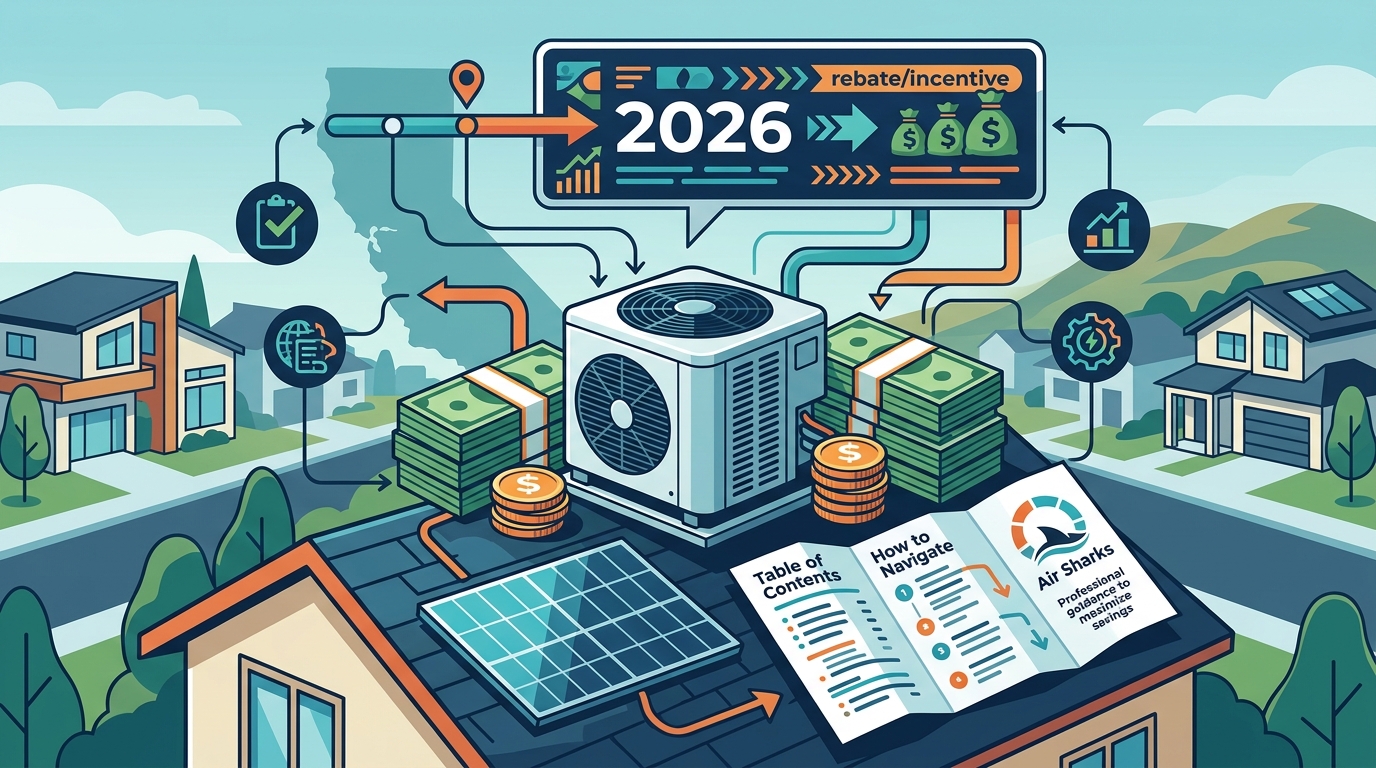
Bay Area homeowners can access substantial financial incentives for heat pump installations in 2026, including federal tax credits and state-level rebates. These programs significantly reduce the upfront cost of high-efficiency heating and cooling systems. This guide details how to navigate the complex landscape of available funds, verify eligibility, and maximize your savings with the help of Air Sharks.
How to Choose: Separating Good Options from Bad
Selecting the right heat pump requires looking beyond the sticker price. A high-efficiency system is defined by its Seasonal Energy Efficiency Ratio (SEER) and Heating Seasonal Performance Factor (HSPF) ratings. In the Bay Area, where temperatures fluctuate, a system with a high HSPF is critical for maintaining comfort during cooler months. You should prioritize units that are listed on the Department of Energy's Most Efficient lists, as these often qualify for the highest tier of rebates.
What to Ask: Specific Questions Before Committing
Before signing a contract, you must ask specific questions to ensure you are getting the best value. First, ask the contractor to perform a Manual J load calculation. This is a standardized method for calculating the heating and cooling load of a building. Without this, you are guessing on the correct size. Second, ask about the warranty terms. Does the manufacturer cover parts and labor, and for how long?
Third, inquire about the rebate process. Will the contractor handle the paperwork for the federal tax credit and state rebates, or is that your responsibility? Finally, ask about the installation timeline. A professional HVAC company like Air Sharks should provide a clear schedule for equipment delivery and installation. These questions help filter out less experienced providers who may cut corners.
How to Verify: Checking Claims and Credentials
Verifying a contractor's credentials is essential to protect your investment. Check if the company is licensed by the California Contractors State License Board (CSLB). You can verify a license number directly on the CSLB website. Additionally, look for NATE (North American Technician Excellence) certification among the technicians. This certification ensures that the installers have passed rigorous exams on HVAC systems.
For rebates, verify that the specific heat pump model is listed on the official rebate program websites. Programs like the California Clean Heating Rebate Program maintain public lists of eligible equipment. If a contractor claims a model is eligible but it is not on the official list, do not proceed. You can also check the Better Business Bureau for any complaints or accreditation status. Air Sharks maintains a strong reputation in the San Jose area, and you can verify their standing through these public resources.
How It Works: The Process and Timeline
Installation typically takes one to three days, depending on the complexity. After installation, the contractor must provide a certificate of completion. This document is required to claim most rebates. For federal tax credits, you claim the credit when you file your taxes for the year of installation. For state rebates, you may need to apply online through the program portal. The entire process, from consultation to rebate claim, can take several months.
What It Costs: Price Drivers
The cost of a heat pump system is driven by several factors. The primary driver is the capacity of the unit, measured in tons. A larger home requires a higher-capacity unit, which costs more. The type of system also affects price. Ductless mini-splits are generally less expensive than ducted systems because they do not require ductwork installation. However, if you need to install new ductwork, the cost increases significantly.
Electrical upgrades are another major cost driver. Modern heat pumps require 240-volt circuits. If your home's electrical panel is old or lacks available space, you may need to upgrade the panel. This can add several thousand dollars to the project. Labor costs vary by region, with the Bay Area typically having higher rates due to the cost of living. Understanding these drivers helps you budget accurately.
What Goes Wrong: Common Mistakes
Homeowners often make mistakes that reduce their savings or lead to poor performance. One common error is choosing a system based solely on price. A cheaper unit may have lower efficiency, resulting in higher energy bills over time. Another mistake is ignoring the importance of duct sealing. If your ducts are leaky, the heat pump will work harder to maintain temperature, negating the efficiency benefits.
Additionally, some homeowners fail to register for rebates in a timely manner. Many programs have deadlines or first-come, first-served funding pools. If you miss the deadline, you lose the incentive. Finally, not verifying the installer's credentials can lead to improper installation, which may void the manufacturer's warranty. To avoid these pitfalls, work with a reputable provider like Air Sharks that handles the entire process, from assessment to rebate filing.
Versus Alternatives: Heat Pumps vs. Traditional Systems
Compared to gas furnaces, heat pumps have lower operating costs in most scenarios. They also produce zero on-site emissions, which is a major benefit for air quality. However, gas furnaces may be more effective in extremely cold climates, though this is less of a concern in the Bay Area. Electric resistance heaters are the least efficient option and are generally not recommended for primary heating. The table below summarizes the key differences.
| Efficiency | High (300-400%) | Medium (80-98%) | Low (100%) |
| Operating Cost | Low | Medium | High |
| Emissions | Zero on-site | CO2 and NOx | Zero on-site |
| Rebate Eligibility | High | Low | None |
For Specific Situations: Tailored Advice
Your specific home situation can change the best approach. If you live in a home with no ductwork, a ductless mini-split system is the ideal solution. It allows you to heat and cool individual rooms, which can save energy if you do not use all rooms equally. If you have a home with existing ductwork but poor insulation, consider pairing the heat pump with an insulation upgrade. This improves the overall efficiency of the system.
Rules and Protections: Your Rights
For rebates, you have the right to accurate information about eligibility. If a contractor misleads you about rebate availability, you can report them to the relevant regulatory body. Keep all documentation, including contracts, invoices, and certificates of completion. These documents are essential for claiming rebates and resolving any disputes. Air Sharks adheres to all state and local regulations, ensuring that you are protected throughout the process.
Local Specifics: Bay Area Details
The Bay Area has specific characteristics that influence heat pump performance and rebate eligibility. The region's mild climate means that heat pumps can operate efficiently year-round. However, coastal areas can experience fog and humidity, which may affect outdoor unit performance. Inland areas, such as San Jose, can experience higher temperatures in the summer, requiring robust cooling capacity.
Timing: When to Act
Timing is critical when claiming heat pump rebates. Many rebate programs have annual funding caps. Once the funds are exhausted, no more rebates are issued until the next year. Therefore, it is best to act early in the year. Additionally, installation schedules can be busy during peak seasons, such as late summer and early winter. Scheduling your installation in the spring or fall can result in shorter wait times.
Federal tax credits are claimed on an annual basis. If you install a heat pump in 2026, you claim the credit when you file your 2026 taxes in 2027. There is no deadline for claiming the federal credit, but you must retain your documentation. State and utility rebates may have specific application deadlines. Check the program guidelines carefully. Acting promptly ensures that you do not miss out on available incentives.
Results Over Time: Long-Term Outcomes
Maintenance is key to long-term performance. Regular filter changes and annual inspections ensure that the system operates at peak efficiency. Neglecting maintenance can lead to reduced performance and higher energy bills. Air Sharks offers maintenance plans that include regular inspections and priority service. By investing in a high-quality heat pump and maintaining it properly, you can enjoy comfortable, efficient, and cost-effective heating and cooling for years to come.
Key Takeaways
- Bay Area homeowners can access federal, state, and utility rebates for heat pump installations.
- Choose high-efficiency units listed on official rebate programs to maximize savings.
- Verify contractor credentials through CSLB and NATE certifications.
- Request a Manual J load calculation to ensure proper system sizing.
- Act early in the year to avoid rebate funding exhaustion.
- Heat pumps are more efficient than gas furnaces and electric resistance heaters.
- Keep all documentation for rebate claims and warranty purposes.
- Regular maintenance is essential for long-term performance and savings.
Frequently Asked Questions
What is the maximum federal tax credit for a heat pump in 2026?
The federal tax credit for heat pumps is typically 30% of the total cost, up to a certain limit. Check the IRS website for the most current limits and eligibility requirements.
Do I need to replace my entire system to get a rebate?
Not necessarily. Some rebates are available for replacing specific components, such as the outdoor unit. However, replacing the entire system often qualifies for higher rebates.
How long does it take to install a heat pump?
Installation typically takes one to three days, depending on the complexity of the job and whether ductwork or electrical upgrades are required.
Are heat pumps effective in the Bay Area climate?
Yes, heat pumps are highly effective in the Bay Area's mild climate. They can provide both heating and cooling efficiently year-round.
Who can help me with the rebate paperwork?
Many HVAC contractors, including Air Sharks, can assist with the rebate paperwork. Ask your contractor if they offer this service.
What is a ductless mini-split system?
A ductless mini-split system is a type of heat pump that does not require ductwork. It consists of an outdoor unit and one or more indoor units, allowing for room-by-room temperature control.